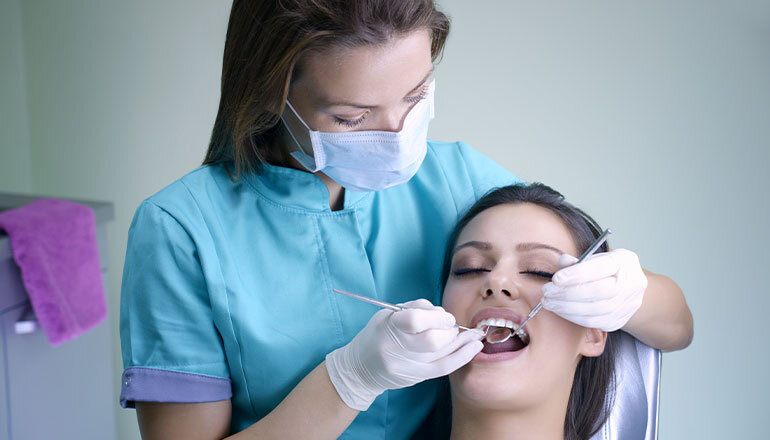
The dental hygienist is a healthcare professional specialized in dental hygiene care, who works independently or in support of dentists. In particular, they focus on the prevention of oral and dental diseases, both by educating patients on how to take care of their own oral hygiene at home and by maintaining it in their professional practice, especially in patients with periodontal disease. The healthcare professional specialized in dental hygiene independently performs, that is, without the supervision of the dentist, the deep cleaning of periodontal pockets. In support of the dentist's work, they may also assist in compiling the patient's medical record. Furthermore, they instruct both adults and children on proper oral hygiene care, also offering advice on a diet suitable for protecting dental health. They have vital plaque detectors that are used to highlight bacterial plaque which, along with tartar, is removed mechanically or manually from the tooth surface. They also take care of polishing the latter and polish and smooth both fillings and fixed or removable prostheses. They whiten teeth for aesthetic purposes. They perform oral cavity prophylaxis procedures, such as topical applications of fluoride, remineralizing agents, sealants, and topical application of desensitizing gels and sprays. They can prescribe mouthwashes, topical fluoride prophylaxis to be performed at home, and over-the-counter oral probiotics useful for rebalancing the oral bacterial flora. They follow the patient to ensure they do not neglect dental hygiene and follow a schedule of dental visits appropriate to their individual condition. The dental hygienist cannot administer anesthesia, treat cavities, or make a diagnosis. For people with disabilities, oral hygiene is the same as for able-bodied people. However, to ensure it can be successfully performed, approaches and communication techniques must change, using special and personalized protocols that also involve parents and educators, who are properly instructed in home care. Oral hygiene is also essential for those who do not eat by mouth, but via enteral or parenteral feeding. In these patients, in fact, there is a greater stagnation of mucus and microbes that can cause aspiration pneumonia, sometimes fatal. In Italy, to practice as a dental hygienist, it is necessary to obtain a first-level degree and professional qualification, or to have a qualification obtained before the current degree course was established and recognized as equivalent or comparable. After obtaining the three-year degree, it is possible to access the master's degree course in health professions technical assistance sciences, which lasts two years. They work in both public healthcare facilities, such as hospitals and clinics, or private ones, such as dental offices. They can be employed under a contract or work as a freelancer. The duties of the dental hygienist
The tools available
What they can prescribe and what they cannot do
Oral hygiene and disability
What is the educational path to become a dental hygienist
Where does the dental hygienist work
© Centro Studi Europeo | All rights reserved 2025 | VAT 05570700657

The dental hygienist: who they are, what they do and where they work
The dental hygienist: who they are, what they do and where they work
2024-01-09 15:51
2024-01-09 15:51
Array() no author 92866
© Centro Studi Europeo | All rights reserved 2025 | VAT 05570700657